

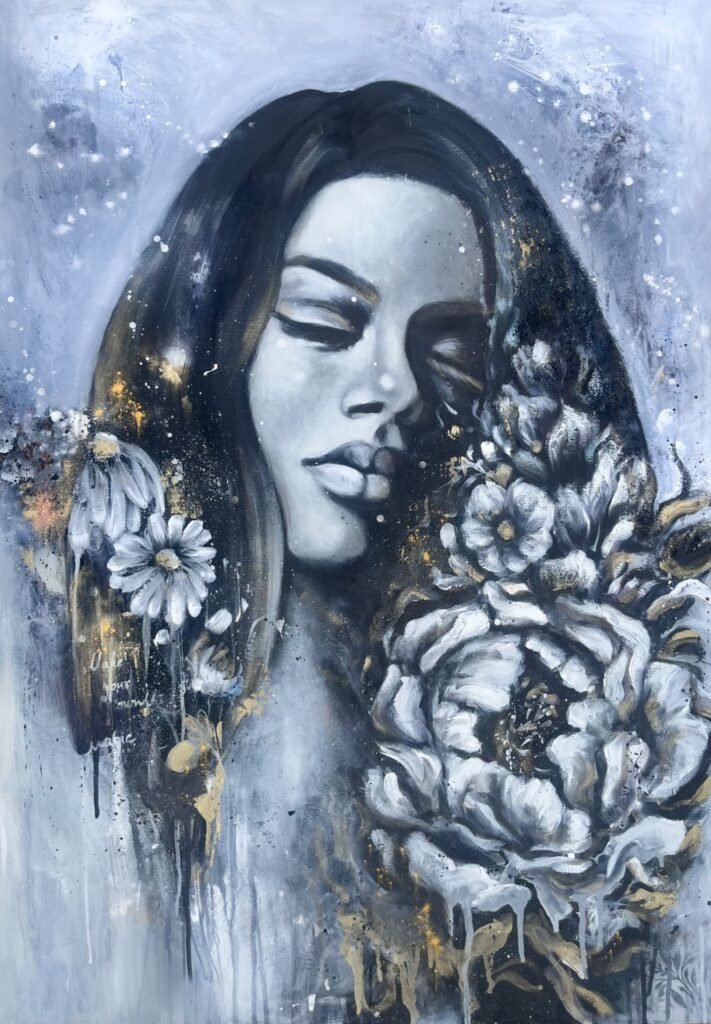
In contemporary physics, time is no longer understood as a fixed, universal flow. Einstein’s theory of relativity revealed that time and space are inseparable aspects of a single fabric—spacetime—capable of bending, stretching, or slowing under the influence of gravity and velocity. Near extreme conditions, such as the singularity of a black hole, time itself appears to break down, approaching a state where its familiar flow ceases altogether.
Quantum theory goes even further, challenging the notion of a single, objective reality. At the quantum level, existence unfolds as a field of probabilities rather than certainties, where multiple potential outcomes coexist until one becomes actualized through observation. In several approaches to quantum gravity, time is not treated as a fundamental building block of the universe, but as an emergent phenomenon—arising from deeper, more subtle relationships that underlie reality itself.
Tantric philosophy approaches time from an entirely different, yet surprisingly resonant, perspective. Here, Time (Kāla) is not merely a dimension to be measured but a living principle, embodied as the Divine Feminine who creates, sustains, and dissolves the cosmos through her eternal dance. Mahākālī represents boundless cosmic time, the ceaseless rhythm of birth and destruction. Dakṣiṇā Kālī embodies the precise instant in which form dissolves back into formlessness. Śmaśāna Kālī presides over liminal spaces and crossings, symbolizing the convergence of parallel existences and multiple planes of being.
Within Tantra, time is often envisioned as a wheel or chakra, where universal cycles, bodily rhythms, and subtle vibrations of awareness interlock into a single dynamic pattern. Rather than moving in a straight line, time circulates, repeats, and transforms, mirroring the pulsation of consciousness itself.
Although modern physics and Tantra employ vastly different modes of expression—one grounded in mathematics and experimentation, the other in symbol, myth, and mantra—they converge on strikingly similar insights. The curvature and dissolution of time near a singularity echo Kālī’s role as the force that consumes all forms. Quantum notions of parallel possibilities find a symbolic counterpart in Śmaśāna Kālī’s domain of intersecting realities. The idea that time arises from deeper structures resonates with the Tantric understanding of mantra, where sound and vibration are not representations of the divine, but the very substance of the Goddess.
Thus, Tantra can be seen as offering a symbolic prefiguration of ideas that modern science has only recently begun to articulate: time as relative and fluid, reality as multi-layered and probabilistic, and existence itself as something that emerges from subtle fields of vibration.
In moments of profound awakening, when Kuṇḍalinī Devī rises, time is no longer experienced as a sequence. It dissolves. Through sacred sound and esoteric mantra—understood as the embodied vibration of the Divine—the realized practitioner moves beyond linear reality, entering dimensions where consciousness is no longer bound by past, present, or future, but rests in the eternal now.